Article
EU261 Flight Delay Compensation Explained
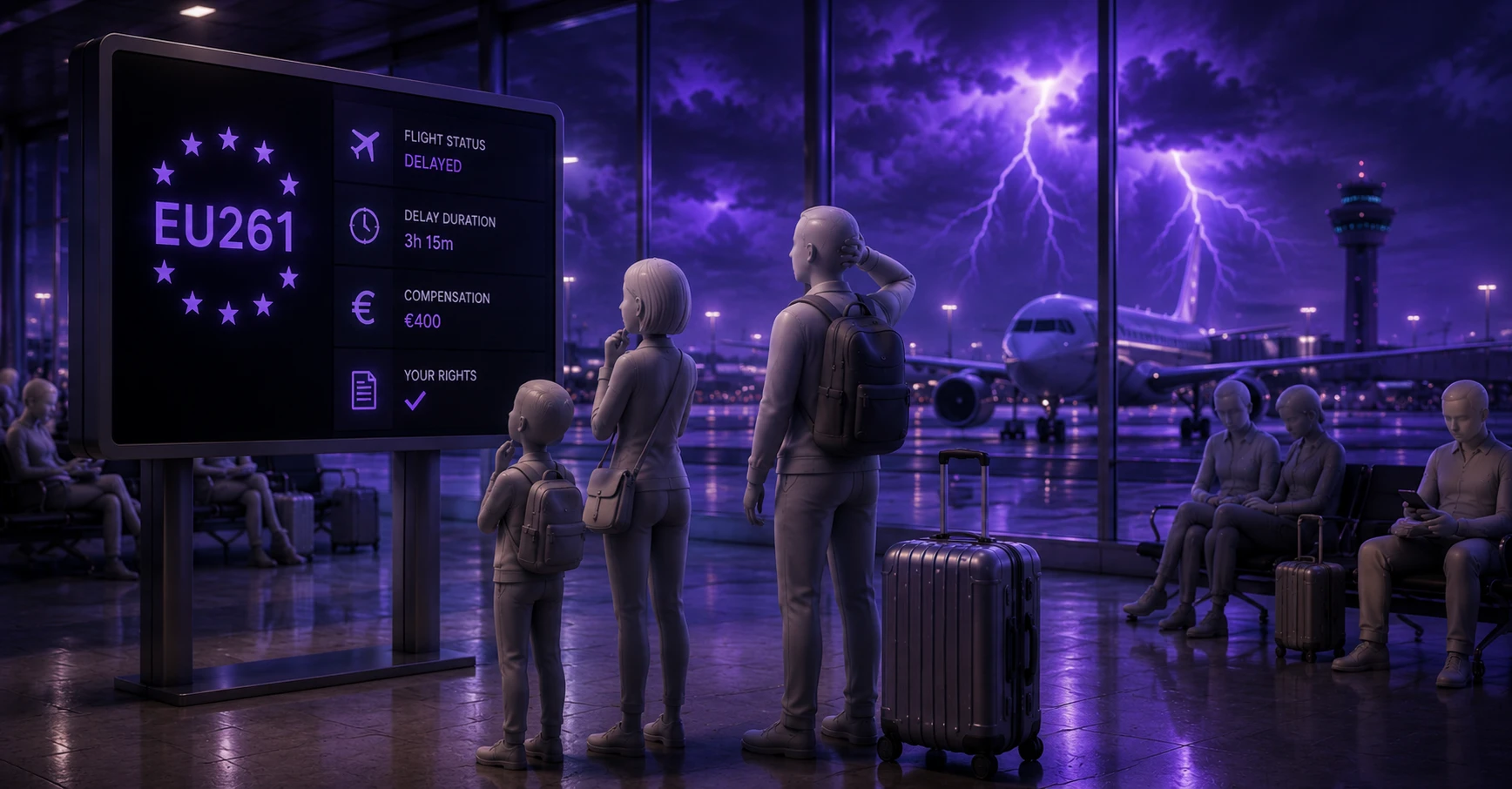
Delayed 3+ hours arriving in the EU or departing from it? You may be owed 250 to 600 euros per passenger. Who qualifies, what airlines must prove, and how to claim.

Written by Wassim · FlightsComp
- EU261
- flight delay
- compensation
- passenger rights
- extraordinary circumstances
Here’s the rule in one sentence: if your flight arrived at your final destination 3 hours late or more, and it departed from an EU airport (any airline) or arrived in the EU on a European airline, the carrier owes you between 250 and 600 euros per passenger, in cash, unless it can prove the delay was caused by something genuinely outside its control.
That’s Regulation EC 261/2004, EU261 for short, and it’s the strongest passenger rights law in the world. Airlines paid dearly to weaken it this year and failed: the EU reform deal reached in June 2026 kept the 3-hour threshold and the full amounts intact after the industry lobbied to raise the bar to four or even six hours. So the rules below are current, and they survived the attack.
Now the details, because the details are where airlines win against passengers who don’t know them.
Does your flight qualify?
Three scenarios, and only the airline and departure point matter, not your nationality or where you bought the ticket:
Departing from any EU airport: covered, whatever the airline. Paris to New York on an American carrier, Frankfurt to Algiers on any airline, covered.
Arriving into the EU: covered only if the airline is EU-based. Montreal to Paris on Air France, covered. Montreal to Paris on Air Canada, not covered by EU261 (though Canada’s own APPR rules apply instead).
UK flights: after Brexit, the UK kept a mirror-image law, UK261, same structure, amounts paid in pounds. Departures from UK airports on any airline, arrivals on UK/EU carriers.
The regulation covers delays, cancellations, denied boarding from overbooking, and downgrades. This guide focuses on delays; cancellations have their own notice rules and their own article.
The 3-hour rule, measured the way courts measure it
Three details here routinely turn “no claim” into “full claim.”
It’s your final destination that counts, not the leg that broke. On one booking, Montreal to Algiers via Paris, a 50-minute delay into Paris that kills your connection and lands you in Algiers 5 hours late is a full-compensation case, even though no single flight was 3 hours late. Connecting itineraries are judged as one journey, a rule that surprises almost everyone.
Arrival time means doors open, not wheels down. The EU court settled it: your arrival time is when at least one aircraft door opens and you can actually get off. Airlines love to count touchdown, which can shave 15 to 25 minutes off the delay, exactly the margin that decides a 2-hour-50 versus 3-hour-05 case. If your delay is borderline, this single fact can be the whole claim.
The distance is measured from origin to final destination, great-circle, across the whole booking. That sets your tier:
| Route distance | Compensation |
|---|---|
| Up to 1,500 km | 250 euros |
| 1,500 to 3,500 km | 400 euros |
| Over 3,500 km | 600 euros |
That long-haul tier covers every transatlantic and most Europe to North Africa itineraries when booked from overseas. Per passenger, not per booking: a family of four on a long-haul delay is a 2,400 euro case. Children with a paid seat count in full.
One caveat for the long-haul tier: if the airline gets you there less than 4 hours late on a 3,500+ km route, it may lawfully halve the 600 to 300. Between 3 and 4 hours late on long-haul, expect that fight.
”Extraordinary circumstances”: the airline’s favorite phrase, decoded
The airline escapes compensation only by proving the delay came from something outside its normal operations AND beyond its actual control, and both parts matter.
What genuinely qualifies: severe weather that actually prevented safe operation, air traffic control restrictions, security threats, political instability, a bird strike, a medical emergency diversion.
What does not qualify, no matter how confidently the rejection letter says it: technical faults discovered in maintenance (courts call these inherent to running an airline), crew shortages and crew scheduling problems, the aircraft arriving late from its previous rotation, and, the one that surprises people most, strikes by the airline’s own staff. When Lufthansa’s or Air France’s own pilots or cabin crew walk out, that’s an internal labor dispute, and European courts have ruled it is not extraordinary. Airport-wide or air traffic control strikes are a different story, those can qualify.
Three more things the rejection letter won’t mention. The burden of proof is on the airline, not you; they must show what happened and that it truly caused your delay, you don’t have to disprove anything. Mixed causes get scrutinized: morning weather doesn’t automatically excuse your evening flight, and when a real extraordinary event combines with the airline’s own sluggish recovery, the airline answers for its share. And even a genuine extraordinary event doesn’t end the analysis, the airline must also show it took all reasonable measures to avoid the delay anyway.
This is why “it was the weather” at the gate, or a template rejection email, should never be where your claim dies. A striking share of extraordinary-circumstances defenses collapse under pressure from someone who knows the case law, which is exactly why a first rejection is the moment to hand the case over, not the moment to give up.
What they owe you while you wait, regardless of cause
Separate from compensation, and owed even when the cause IS extraordinary: care. From 2 to 4 hours of delay depending on distance, meals and refreshments. Communication (calls, emails). If the delay pushes overnight, a hotel plus transport to it. And past 5 hours of delay, the right to abandon the trip entirely for a full refund of the unused ticket.
If the airline doesn’t provide care, provide it for yourself reasonably and keep every receipt: those expenses are reimbursable on top of any compensation. Storm delays don’t pay 600 euros, but they absolutely pay for your dinner and your hotel.
What to keep, starting now
You don’t need to know how to fight an airline. You just need to not throw away the ammunition.
Keep the booking confirmation and boarding passes. Keep every email or SMS the airline sent about the delay. Screenshot the flight’s actual arrival time from a flight tracker the same week, that data gets harder to find later. Keep receipts for anything the delay made you buy. And if staff gave you a reason at the airport, write it down word for word, because airlines’ stories have been known to improve between the gate and the claims department.
That’s it. That folder of screenshots is the difference between a strong case and a maybe.
And know this about timing: the deadlines to claim are long, roughly 3 years in Germany, 5 in France and Spain, 6 in England. That delay from last summer, or the summer before? Very likely still alive.
Where I come in
Here’s the honest math of this industry: airlines reject first and reconsider only under pressure, because most passengers stop at the first no. The rejection letter is written to be the end of the story. Making it the middle of the story is my job.
Send me your booking confirmation and a few lines about what happened. I’ll review the case honestly and tell you what it’s worth, including when the answer is that you don’t have one. If there’s money, I handle everything with the airline, and I take a 25 percent success fee only when it’s recovered (see how pricing works). No win, no fee, and you never write a single letter.
Related articles

Wassim · FlightsComp
"I spent years inside the airline industry before founding FlightsComp. I started this because too many travelers, especially in our community, walk away from money they're owed. I take your case personally, handle the airline directly, and only get paid if we win."